
NEWS | Conservation Agreements Signed for Khaltan, Galajig and Mudri in Azerbaijan
Updated: Aug 4
New Conservation Agreements Signed in Azerbaijan.

Boardrooms are not where community-based nature conservation happens. It’s the fields, forests and mountain pastures where the real work is done. Yet, from time to time, boardrooms and conference halls become an important part of the journey where maps and reports are presented, where progress is shared, and perhaps most importantly, where signatures turn hard work into lasting commitments.
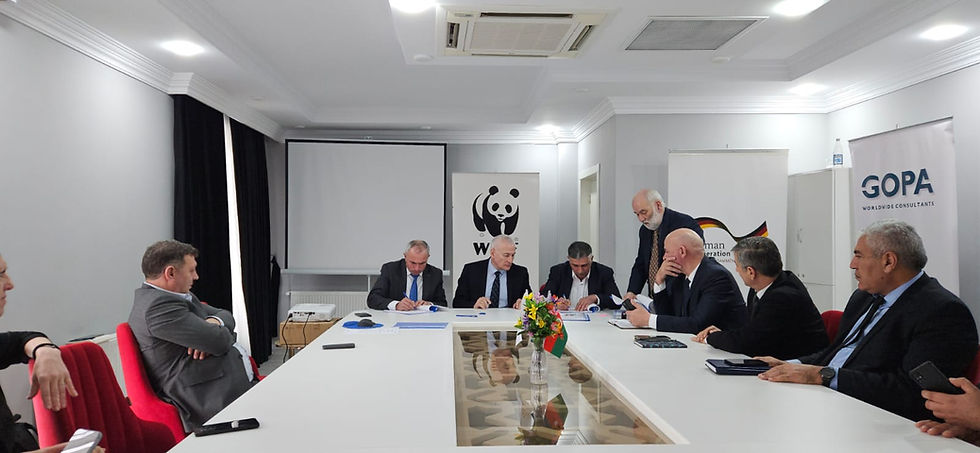
At the end of January, two such boardrooms in Guba and Ismayilli, districts in northern Azerbaijan, became the setting for important Eco-Corridors Fund (ECF) milestones. Community leaders, government representatives and conservation partners gathered not simply to sign documents, but to reaffirm a shared commitment to protecting Azerbaijan's wildlife habitats and supporting the communities that care for them.
The first ceremony took place on January 27th 2026, in Guba, where the ECF Conservation Agreements for the community of Khaltan were officially signed. Representatives from the Executive Authority of Guba District, the Forest Development Service under the Ministry of Ecology and Natural Resources, WWF Germany, WWF Georgia and members of the Khaltan community came together to celebrate a shared commitment to protecting the area's rich biodiversity.
As an introduction, ECF Chief Technical Advisor Jernej Stritih outlined the progress of ECF II, highlighting how ecological corridors help connect habitats, support wildlife movement and strengthen ecosystems in the face of climate change. He explained that by working across borders and with local communities, the programme aims to create healthier, more resilient landscapes throughout the Southern Caucasus, while supporting the economic development of the involved communities.
Participants were then presented with the Wildlife Habitat Conservation Plan for the Khaltan Conservation Area (2026–2035) that will be supported by the Conservation Agreement signed on the day. The plan sets out practical actions for the coming decade, including habitat restoration, wildlife monitoring, preventing illegal hunting, raising awareness within local communities and supporting sustainable livelihood opportunities that complement conservation efforts.
The ceremony concluded with representatives of the Khaltan Community-Based Organisations (CBOs), WWF and the Guba Executive Authority signing the agreement, marking the beginning of a long-term partnership built on shared responsibility for the conservation of the landscape.
Just two days later, on January 29th, a similar milestone was celebrated in Ismayilli, where Conservation Agreements for the Galajig and Mudri conservation areas were officially signed.
Representatives of the Executive Authority of Ismayilli District, the Forest Development Service, WWF Germany, WWF Georgia, and members of both communities gathered for the occasion, demonstrating the strong collaboration among national institutions, international partners, and local people.
The meeting also introduced the Wildlife Habitat Conservation Plans for Galajig and Mudri (2026–2035). Similar to the Khaltan plan, these outline practical conservation measures, including habitat restoration, wildlife monitoring, camera-trap installation, efforts to combat illegal hunting, awareness-raising activities, and initiatives that support sustainable local livelihoods.
The event concluded with the signing of the Conservation Agreements by representatives of the Galajig and Mudri CBOs, Ismayilli Executive Authority and WWF. While the ceremonies marked the formal beginning of these partnerships, they also represented a shared commitment to ensuring that the people who know these landscapes of Azerbaijan best are central to protecting them for generations to come.
*


